

SLDbatt represents a coordinated effort by a unique Dutch consortium to bring three LDES technologies, each based on abundant, recyclable, and non-critical materials, to TRL 6–7. These technologies collectively offer a breakthrough in cost, safety, modularity, and sustainability:
NaCl-salt based Battery (EXERGY STORAGE)
A low-cost, safe and high-energy-density (up to ~100 Wh/kg cell-level) storage system. Using sodium chloride and (recycled) aluminum with NaAlCl₄ electrolyte at intermediate temperature. Key innovations include:
- One-step low-cost synthesis of high-purity NaAlCl₄ through collaboration Nobian and Exergy
- New cathode designs enabling larger cell capacities (1–4 kWh per cell)
- Scalable to containerized MWh systems with discharge durations of 16–100 hour
- Decentralized and modular systems allow for high flexibility and safety
Acid-Based Flow Battery (AQUABATTERY)
AQUABATTERY is a Dutch clean-tech innovator that has developed a novel Acid-Base Flow Battery specifically designed for Long-Duration Energy Storage (LDES). At the heart of the system is a saltwater-based flow battery that uses only highly abundant, non-toxic, and non-flammable materials (water and table salt) as the primary storage medium.
How It Works: A Fully Reversible Cycle
The technology operates on the principle of reversible water dissociation, enabled by a patented bipolar membrane stack.
1. Charging (Storing Energy)
Electricity from renewable sources powers a bipolar membrane electrodialysis process. Saltwater flows through the membrane stack, where water molecules dissociate into acid (H⁺) and base (OH⁻). These two energy-rich streams are collected and stored in separate external tanks.
2. Discharging (Releasing Energy)
When electricity is required, the stored acid and base solutions are returned to the membrane stack. As they recombine to form neutral saltwater, their chemical potential energy is converted back into electrical power, supplying the grid or end user.
Key Advantages for LDES
- Sustainability & Safety
Using only water and NaCl eliminates dependence on scarce, flammable, or toxic raw materials. The system is inherently fire-safe and built on a robust, sustainable supply chain. - Scalable by Design
Power (kW) and energy capacity (kWh) are fully decoupled. Extending storage duration simply requires larger acid/base tanks: an inexpensive and modular way to scale from hours to multi-day storage. - Long Lifetime & Reliability
The active materials (salt and water) do not degrade, enabling long component lifetimes (~20 years) and supporting a low Levelized Cost of Storage (LCOS) for long-duration applications.
Hydrogen-Iron Flow Battery (Elestor)
The lowest cost LDES system based on H2-Fe redox couple in a hybrid gas-liquid system with:
- Catalyst-coated electrodes manufactured via a groundbreaking non-solvent induced phase separation process for improved reactant distribution
- Advanced electrolytes and stack designs
- Flow visualization methods for validating CFD models and improving scale-up
LDES technologies are one means among several to achieve greater electrification and a more flexible grid. Other solutions potentially include combinations of redundancy/overbuilding renewable energy supply, expansion of (fast-ramping) fossil fuel-based power plants (with carbon capture), grid expansions including (internationally) interconnected HVDC power lines and advanced infrastructure, green hydrogen use and infrastructure—but taking the critical factors into account of sustainability, costs, timelines of construction, and geopolitical factors, battery energy storage is a critical part of the solution, and LDES in particular reduces the costs and risks in building out a highly dynamic, flexible, and resilient grid.
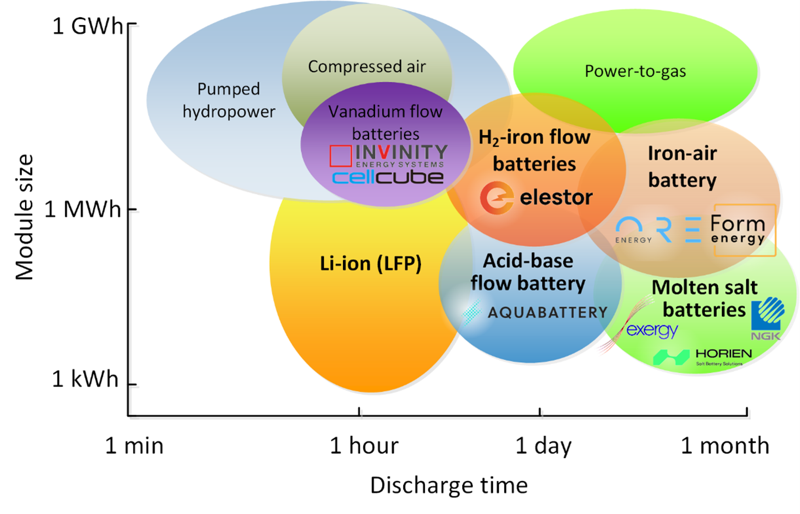
Figure 1: Energy capacity (y-axis) vs. Discharge time (x-axis) for LDES technologies. Highlighted are SLD Batt consortium technologies (Exergy, AQUABATTERY, Elestor), and SLD Batt supporting partner ORE Energy, compared to other emerging systems (e.g., iron-air, power-to-gas), early commercial (e.g., vanadium flow, molten salt technology at high temperature (NGK and Horien)) and mature technologies (Li ion, compressed air, pumped hydro). The figure illustrates the distinct operational niches and performance characteristics of these technologies across the storage spectrum. The full operational ranges and function capabilities of each technology might extend beyond the regions indicated here; however, this figure highlights leveraging the uniqueness of each technology within the indicated areas.